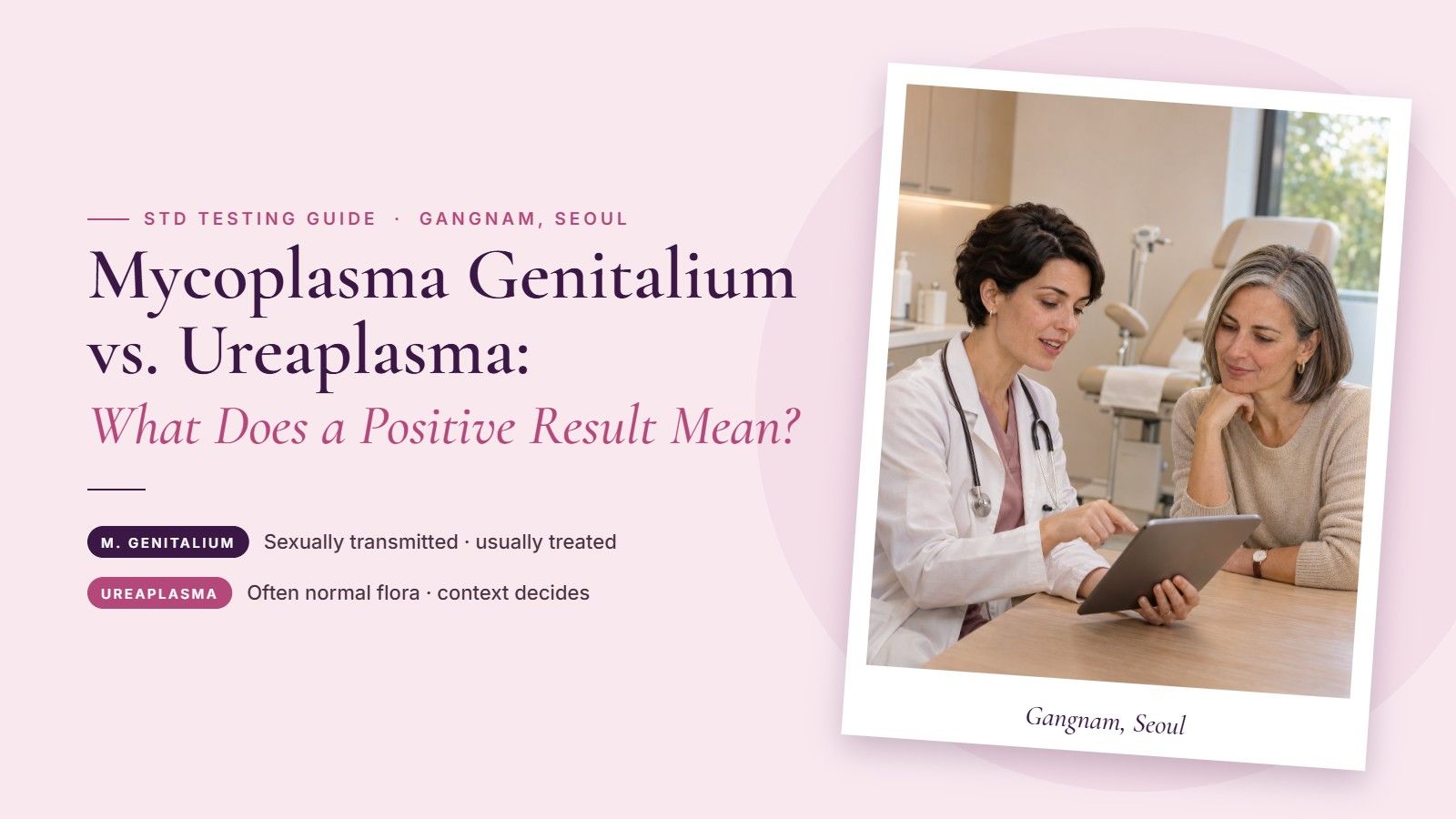
Why Is Ureaplasma on Some STI Panels? When Might Treatment Be Considered?
Ureaplasma appears on many panels because multiplex PCR tests check many organisms from one sample. Ureaplasma is commonly found in healthy women, so a positive result alone usually does not mean treatment. Treatment may be considered with persistent symptoms and no other cause, or in specific situations your doctor identifies.

Multiplex STI PCR panels are popular in Korea because one swab can check a dozen or more organisms. The downside is that they also report organisms that are frequently harmless, such as Ureaplasma. Understanding why it is listed helps you avoid unnecessary worry and unnecessary antibiotics.
Why Ureaplasma is on the panel
Technology
Multiplex PCR can detect many organisms at once, so labs include several related species.
Research interest
Ureaplasma has been studied in relation to some symptoms and pregnancy outcomes.
Completeness
Panels aim to give a broad picture of the vaginal microbiome.
Interpretation needed
A positive result is information, not automatically a diagnosis.
When treatment may be considered
| Situation | Usual approach |
|---|---|
| No symptoms | Often no treatment |
| Persistent symptoms, other causes ruled out | Treatment may be considered |
| Partner with symptoms and positive result | Discussed case by case |
| Specific fertility or pregnancy situations | Your doctor will advise |
Questions to ask your OBGYN
- Is this normal for me? Ask whether the result explains your symptoms.
- Were other causes checked? Bacterial vaginosis, yeast and other STIs can cause similar symptoms.
- What are the risks of treating? Antibiotics have side effects and can affect healthy bacteria.
- Do I need follow-up? Ask if retesting is useful.
Reading your PCR report
- Find the exact name Ureaplasma urealyticum and Ureaplasma parvum may be listed separately.
- Check the other results Look at chlamydia, gonorrhea, trichomoniasis and M. genitalium.
- Match with symptoms Your doctor connects the report to what you are experiencing.
- Decide together Agree whether treatment, monitoring or further tests are best.
Frequently asked questions
Why is Ureaplasma tested if it is often normal?
Multiplex PCR panels test many organisms at once, and Ureaplasma is included as part of that broad picture.
Should I take antibiotics for a positive Ureaplasma result?
Not automatically. Treatment is usually reserved for persistent symptoms or specific situations.
Can Ureaplasma cause symptoms?
It has been linked to symptoms in some cases, but other causes are usually checked first.
Is Ureaplasma sexually transmitted?
It can be shared between partners, but it is also commonly found in people who are not sexually active.
Does my partner need treatment?
This is decided case by case. Ask your doctor.
Positive Ureaplasma result?
Don't panic. Ask your OBGYN whether it explains your symptoms before starting antibiotics.
Related guides
This article is for general information and does not replace a medical consultation. Tests, treatments and prices can vary. Please speak with a doctor about your individual situation.